

The Impact of Excessive Cylinder Thrust on Workpieces
1. Introduction
Cylinder thrust powers pressing, clamping and positioning in automated equipment. But once thrust exceeds what the workpiece can handle, it turns from a helper into a destructor—causing damage ranging from surface dents to internal cracks. How bad the damage gets depends on contact pressure, end-of-stroke impact, workpiece material, and how long pressure is held.
2. How Much Thrust Does a Cylinder Produce?
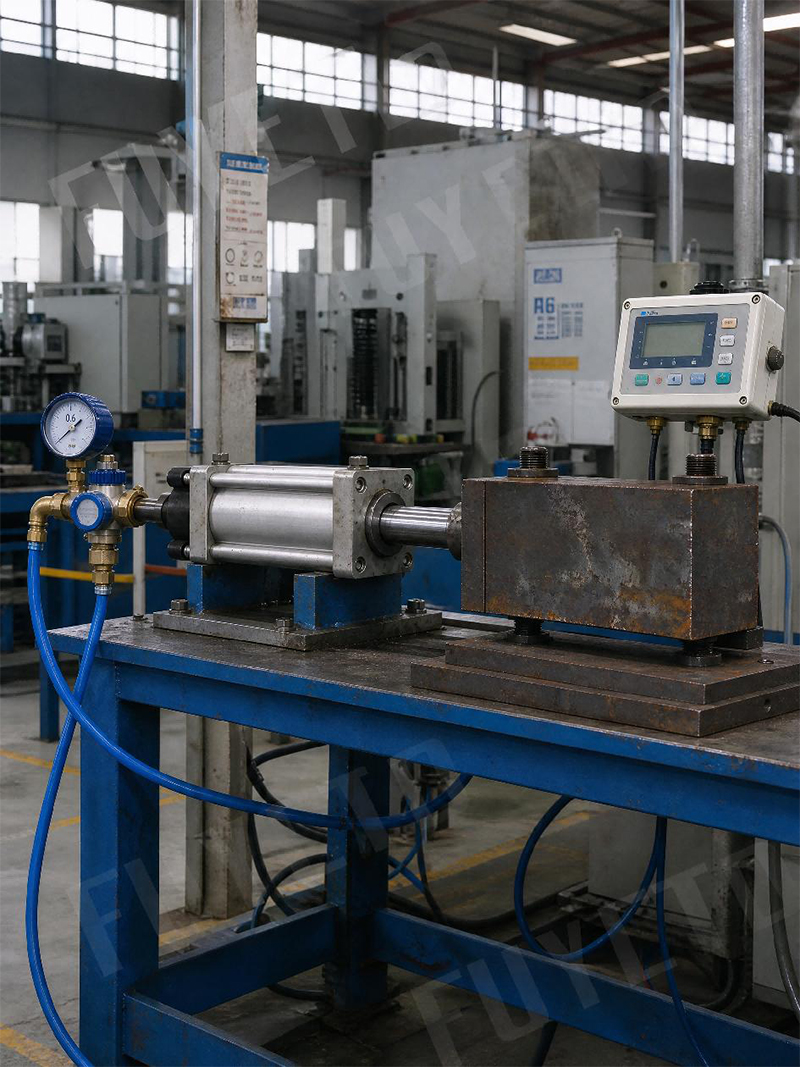
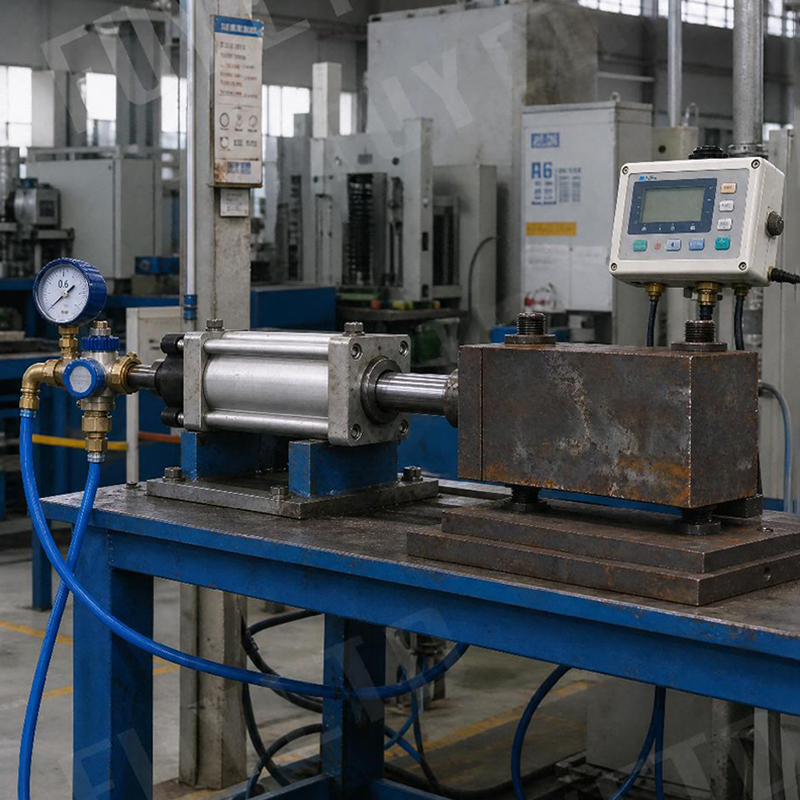
Thrust = air pressure × effective piston area. Extension: F = π/4 × D² × P; Retraction: F = π/4 × (D² − d²) × P. (D = bore, d = rod diameter, P = working pressure). Actual thrust is lower than theory due to seal friction and back pressure—typically 70%–90% of theoretical (about 90%–95% extension, 85%–90% retraction). Table 1 shows reference values for common bore sizes.
Table 1 Reference theoretical thrust for common bore sizes (approximate)
| Bore (mm) | Thrust @ 0.5 MPa (N) | Thrust @ 0.6 MPa (N) |
| 25 | ≈245 | ≈295 |
| 32 | ≈402 | ≈482 |
| 40 | ≈628 | ≈754 |
| 50 | ≈982 | ≈1178 |
| 63 | ≈1559 | ≈1870 |
| 80 | ≈2513 | ≈3016 |
| 100 | ≈3927 | ≈4712 |
For example, a 63 mm bore cylinder at 0.6 MPa pushes about 1.9 kN (≈190 kgf). That's a lot of force acting on a small workpiece.
3. What Excessive Thrust Does to Workpieces
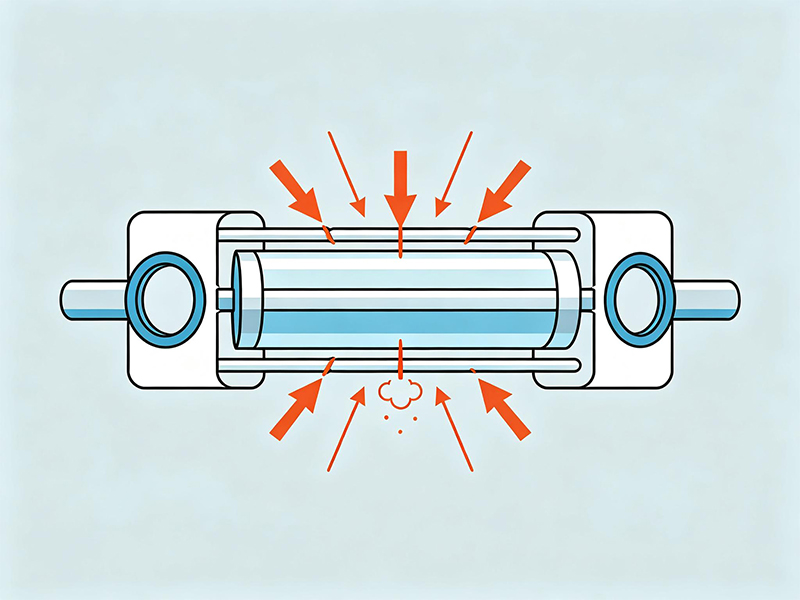
Excessive thrust causes more than just visible damage—it hits five different ways, summarized in Table 2.
Table 2 Main impacts of excessive thrust on workpieces
| Impact category | Typical signs | Mechanism |
| Surface damage | Dents, impressions, scratches | Contact pressure exceeds surface capacity |
| Deformation & dimensional deviation | Plastic deformation, bending, dimensional scrap | Force exceeds material yield strength |
| Positioning accuracy affected | Workpiece shifted, rebound, misalignment | Thrust exceeds locating/clamping force |
| Hidden internal damage | Stress concentration, micro-cracks | Repeated loading, sustained pressure |
| Collateral fixture damage | Loose locating pins, cracked clamps | Shock and fatigue transmitted to fixtures |
3.1 Surface Damage
Soft materials (aluminum, plastics) get dents and marks directly. Harder materials (steel) may show impressions or scratches. Either way, appearance and surface finish suffer.
3.2 Deformation and Dimensional Deviation
When thrust exceeds the material's yield strength, the part bends or deforms permanently. For precision parts, this means instant scrap—it's one of the most serious outcomes.
3.3 Positioning Accuracy Affected
If thrust overcomes the locating or clamping force, the workpiece shifts or tilts. It may even rebound after positioning, ruining repeat accuracy and batch consistency.
3.4 Hidden Internal Damage and Fatigue
Repeated loading or long pressure holding creates stress concentration and even micro-cracks inside the part. This damage is invisible on the surface—it only shows up later during machining or service, which makes it extra dangerous.
3.5 Collateral Damage
Excess thrust also damages fixtures: locating pins loosen, clamp plates crack. Bad fixturing then causes even more parts to be made wrong.
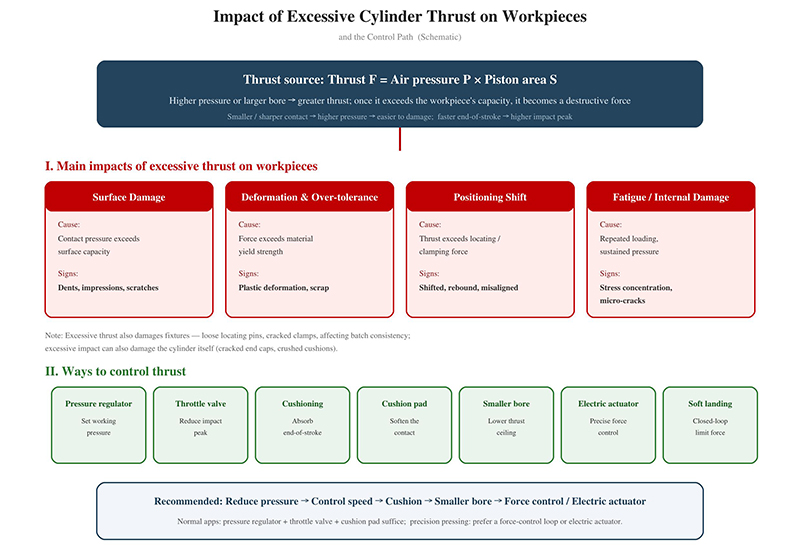
Figure 1 The impact of excessive cylinder thrust on workpieces and the control path
4. What Makes the Damage Worse?
4.1 Contact Pressure, Not Total Force
It's not total force that matters—it's contact pressure (force ÷ contact area). The same 1,000 N spreads thinly on a flat pad, but concentrates sharply on a point. Sharp or small contact = higher pressure = easier damage. This is a common blind spot.
4.2 End-of-Stroke Impact Peak
Fast cylinders create impact spikes at end-of-stroke that are much higher than steady thrust. Impact energy scales with the square of speed—double the speed, quadruple the energy. Often it's this instant impact, not steady force, that breaks things.
4.3 Workpiece Material and Structural Rigidity
Soft materials dent easily. Harder materials tolerate more but still show impressions. Thin-walled and low-rigidity parts deform much more readily. Precision parts are the most unforgiving.
4.4 Sustained Pressure-Holding
If the cylinder stays pressurized after reaching position, the part is under constant load. Even if the force is below the instant damage threshold, prolonged holding causes slow creep deformation—especially critical for precision workpieces.
5. How to Prevent Excessive Thrust Damage
5.1 Pressure Regulator (Most Direct)
Install a pressure regulator and set working pressure to what you actually need. Don't run at full system pressure. Leave margin.
5.2 Throttle Valve for Speed Control
Add a one-way throttle valve to slow down end-of-stroke speed and cut the impact peak. This protects the workpiece, the fixture, and the cylinder itself.
5.3 Use or Add Cushioning
Use the cylinder's built-in adjustable cushioning, or add an external shock absorber. Turns a hard slam into a soft deceleration.
5.4 Cushioning Pad at the Contact Surface
Put an elastic pad between the pusher and the workpiece. Even if thrust is a bit high, the real impact on the part drops a lot.
5.5 Use a Smaller Bore Cylinder
If you don't need much force, use a smaller-bore cylinder. Reducing the bore lowers the maximum thrust from the source.
5.6 Electric Actuator Alternative (High-Requirement Applications)
For high-precision needs, an electric actuator controls thrust precisely and doesn't fluctuate with air pressure.
5.7 Load Cell + Force-Control Loop (Precision Applications)
For precision pressing, add a load cell for closed-loop force control—decelerate near the end, then hold a controlled force. This is the standard for delicate assembly.
6. Summary
Excess cylinder thrust causes five problems: surface damage, deformation, positioning shift, internal fatigue, and fixture damage. Control it in this order: reduce pressure → slow the speed → add cushioning → smaller bore → force control / electric actuator. For most jobs, a regulator, throttle valve, and cushioning pad are enough. For precision work, go with force control or an electric actuator.
xhaust back pressure.